When I first moved back to Berkeley a year ago, I was worried about getting coffee from my favorite San Francisco roasters. It quickly became clear that this would not be a problem. Caffe Mediterraneum on Telegraph sells beans from Barefoot, Local 123 sells beans from Flying Goat, and there's a Blue Bottle stand at the downtown Farmers' Market Saturday mornings. I could go on as there seem to be more options every month or two. (There's still nothing in downtown Berkeley, though. In downtown Oakland, there's Modern: Coffee and Cafe Gabriela.)
However, I've started buying coffee roasted at the Coffee Market on Hopkins near the Monterrey Market. The roaster doesn't have a particular "style", but his lighter roasts seem similar enough to those above that it looks to become my much cheaper alternative to them. He also sells his roasted beans in pound bags at the Country Cheese store on San Pablo near University.
Monday, November 15, 2010

Friday, November 12, 2010
Democratic Death Wish
Jane Hamsher and Atrios comment on attempts to make a free trade pact with Korea
and the "budget balancing" (linked by JH) proposals, respectively.
For more context, see this post from Mike Lux about the proposals of the National Commission on Fiscal Responsibility and Reform ("Catfood Commission").
and the "budget balancing" (linked by JH) proposals, respectively.
opposing NAFTA-style trade agreements and defending Social Security were the two strongest issues Democrats had in 2010
The Korea FTA text contains the extreme investor rights that promote offshoring; the private enforcement of those rights that had led to serial attacks on domestic environmental, health, and other safeguards; a ban on Buy America; limits on financial service regulation ( recall, this is a 2007 pre-crisis text with all of the crazy extreme dereg language of past Bush FTAs) and more of the most damaging NAFTA-style provisions Obama promised to fix.
For more context, see this post from Mike Lux about the proposals of the National Commission on Fiscal Responsibility and Reform ("Catfood Commission").
Saturday, November 06, 2010
Problem: Banks
Detailed yet succinct summary from James Galbraith: Obama's Problem Simply Defined: It Was the Banks.
I'm in the earlier parts of JG's Predator State. My impression so far is that the writing's not that great, but is sufficient to convey content I find very interesting.
Law, policy and politics all pointed in one direction: turn the systemically dangerous banks over to Sheila Bair and the Federal Deposit Insurance Corporation. Insure the depositors, replace the management, fire the lobbyists, audit the books, prosecute the frauds, and restructure and downsize the institutions. The financial system would have been cleaned up. And the big bankers would have been beaten as a political force.
Team Obama did none of these things. Instead they announced “stress tests,” plainly designed so as to obscure the banks’ true condition. They pressured the Federal Accounting Standards Board to permit the banks to ignore the market value of their toxic assets. Management stayed in place. They prosecuted no one. The Fed cut the cost of funds to zero. The President justified all this by repeating, many times, that the goal of policy was “to get credit flowing again.”
The banks threw a party. Reported profits soared, as did bonuses. With free funds, the banks could make money with no risk, by lending back to the Treasury. They could boom the stock market. They could make a mint on proprietary trading. Their losses on mortgages were concealed — until the fact came out that they’d so neglected basic mortgage paperwork, as to be unable to foreclose in many cases, without the help of forged documents and perjured affidavits.
But new loans? The big banks had given up on that. They no longer did real underwriting. And anyway, who could qualify? Businesses mostly had no investment plans. And homeowners were, to an increasing degree, upside-down on their mortgages and therefore unqualified to refinance.
I'm in the earlier parts of JG's Predator State. My impression so far is that the writing's not that great, but is sufficient to convey content I find very interesting.
Friday, November 05, 2010
All My Exes Live in Berkeley
We moved back here about a year ago. Since that time, I have run into four ex-girlfriends in a three by three square block area of downtown Berkeley. I said hi to the one I'm on good terms with and avoided the other three.
K turns 0.75
I've clearly been remiss in not posting that we had a second boy, K. He has three teeth, has just started crawling, and is nine months old today.
Primary Obama
While the Obama administration has been getting testy about those professional leftists disgruntled with them, it's not that much of a mystery why, as partially outlined here by Glenn Greenwald ("The Profound Mystery of the Enthusiasm Gap", Sept 2): broken promises on immigration reform, gay rights, civil liberties, labor rights, protection of Social Security, government transparency, etc. To Glenn's list I would also add a health care "reform" that keeps the useless private insurance companies in charge, guaranteeing them millions more subsidized customers, dealing away a public option in closed-door deals with insurance companies.
Given that all Democratic base constituencies were betrayed, who has the Obama admin been serving? The finance industry. Please read all of this fairly short piece, "The Oligarch's President" by Charles Ferguson (director of "Inside Job", BS Math, PhD Poli Sci). Here, though, are a few excerpts:
What to do? Ian Welsh sums it up well here: "The Primary Obama Movement Begins Today":
I have been a supporter of publicly funded campaigns for some time now, since it became clear that Republicans cared only about funneling money to their rich buddies and not dealing with any of the urgent problems our country faces (see Ian's list, above). However, now that it (1) the Roberts court is declaring a key feature of Clean Money Elections unconstitutional (see Davis v. FEC) and (2) Democrats have changed the politics but not so much the policies from the Bush admin, election reform can only be part of a broader effort. I'm not sure how we go about mounting a primary challenge to Obama, but I believe Ian is right. We must.
Given that all Democratic base constituencies were betrayed, who has the Obama admin been serving? The finance industry. Please read all of this fairly short piece, "The Oligarch's President" by Charles Ferguson (director of "Inside Job", BS Math, PhD Poli Sci). Here, though, are a few excerpts:
Beginning almost immediately, the president consistently opposed any effort to control financial industry compensation -- even for firms receiving federal aid, as most were in 2009. Then came a long period of total inaction, followed by the toothless Wall Street reform bill passed this summer and the appointment of a former Fannie Mae lobbyist, Tom Donilon, as the new national security advisor.
Most tellingly, there has not been a single criminal prosecution of any firm or any individual senior financial executive -- literally zero -- and, of course, no appointment of a special prosecutor. While we can debate the extent to which fraud caused the crisis, and precisely how much fraud was committed, the answer is clearly not zero. We already know that Lehman and other firms used fake accounting to hide liabilities and inflate assets; that lenders and securitizers frequently knew that the loans they sold and packaged were fraudulent or defective; and, of course, we also now know that Goldman Sachs and other investment banks sold securities they knew to be defective...
It is, in short, overwhelmingly clear that President Obama and his administration decided to side with the oligarchs -- or at least not to challenge them.
What to do? Ian Welsh sums it up well here: "The Primary Obama Movement Begins Today":
Obama and Democrats had a historic chance to fix America. The rich who run America, whom the Supreme Court in Citizens United gave permission to outright buy elections, could have been broken when Obama took power. All that was necessary was to force them to take their losses. Contrary to what apologists for wealth have told you, this would not have meant disaster for the economy, there were ways to protect regular Americans while making the rich take their losses.
Instead Barack Obama, as in so many other ways, continued Bush’s policies, and kept the rich bailed out. The end result has not only been the tsunami of foreclosure issues which still threaten to swamp the banks, has not only been trillions in dollars of taxpayer money being used to keep rich people rich (much more money than was spent on the stimulus), it has been the wholesale transfer of money from poor to rich: an absolute decline in total wages, average wages and median wages of ordinary Americans, while Wall Street pays themselves even higher bonuses than before, gives record money to Republicans and the rich pay themselves more.
Obama must be primaried and he must be primaried from the left
The left must be seen to repudiate Obama, and they must be seen to take him down. If the left does not do this, left wing politics and policies will be discredited with Obama. This is important not as a matter of partisan or ideological preference, it is important because left wing policies work. It is necessary to move back to strongly progressive taxation, it is necessary to force the rich to take their losses, it is necessary to deal with global warming, it is necessary to deal with the fact that the era of cheap oil is over, it is necessary to stop the offshoring engine which is destroyin the American middle class.
I have been a supporter of publicly funded campaigns for some time now, since it became clear that Republicans cared only about funneling money to their rich buddies and not dealing with any of the urgent problems our country faces (see Ian's list, above). However, now that it (1) the Roberts court is declaring a key feature of Clean Money Elections unconstitutional (see Davis v. FEC) and (2) Democrats have changed the politics but not so much the policies from the Bush admin, election reform can only be part of a broader effort. I'm not sure how we go about mounting a primary challenge to Obama, but I believe Ian is right. We must.
Thursday, August 27, 2009
Who'd I Marry?
A few nights ago, I had a dream in which I could not remember or figure out whom I had married. It had the quality of one of those dreams in which you have a big exam or paper due soon and you are stressed out about it but are completely unable to focus on it. The "thought process" went something like, "Ok, it can't be her. I think it must be her instead. But, wait. I would have married her then, and I'm pretty sure I slept with her more recently, so that doesn't seem right..." Much like the exam dreams, I was quite relieved when it dissolved upon waking. I could remember only a couple of the possible "candidates" and neither was anyone I would have remotely considered marrying. I told L about it, and she said she had had the same dream a couple months ago.
Thursday, August 13, 2009
brief coffee updates
1. slightly simplified french press method:
Get another small, preferably thin, cup. When you've pre-heated your press and plunger, pour the water into the thin cup and put the plunger in to keep it warm.
Pour all the water in onto the grounds in one pour, in a thin smooth stream. Wait one minute, and begin the tapping. When the tapping is done (30 - 60 seconds later), put in the plunger and use it to press the floating grounds a small ways into the liquid.
Total steep time: 4 minutes.
2. Four Barrel's roasting style strikes me as somewhere between Blue Bottle's and Ritual's. They still keep a lot of the bright acids, as Ritual does, but also bring out more of the coffee richness, as Blue Bottle does. And they have selection of beans I find most interesting these days.
Get another small, preferably thin, cup. When you've pre-heated your press and plunger, pour the water into the thin cup and put the plunger in to keep it warm.
Pour all the water in onto the grounds in one pour, in a thin smooth stream. Wait one minute, and begin the tapping. When the tapping is done (30 - 60 seconds later), put in the plunger and use it to press the floating grounds a small ways into the liquid.
Total steep time: 4 minutes.
2. Four Barrel's roasting style strikes me as somewhere between Blue Bottle's and Ritual's. They still keep a lot of the bright acids, as Ritual does, but also bring out more of the coffee richness, as Blue Bottle does. And they have selection of beans I find most interesting these days.
I like the worm (not about tequila)
At that weekend wedding in Point Reyes, a lot of the apples we picked had been invaded by worms. However, since the worms had just eaten the seeds and then left, this worked out fine. I just cut out the usual core, and J and I ate the rest.
In one apple we did finally find a worm. (I think it was not really a worm, but a caterpillar or a maggot.) It was a pretty pink color and was mostly intact. J noticed that it was missing one end, though, and said something to me about my having cut its head or tail, and asked why. I told him I had accidentally cut it off when I was opening the apple. He said, "I don't wan do that again. I like the worm."
In one apple we did finally find a worm. (I think it was not really a worm, but a caterpillar or a maggot.) It was a pretty pink color and was mostly intact. J noticed that it was missing one end, though, and said something to me about my having cut its head or tail, and asked why. I told him I had accidentally cut it off when I was opening the apple. He said, "I don't wan do that again. I like the worm."
Returning from an unplanned detour (long)
On the last day in July, L, J and I went up to friends' weekend wedding in Point Reyes. The surroundings were beautiful and we were glad for a weekend away from the city. There was a small creek behind the hotel which J loved. And I could pick fresh apples and blackberries from the plants on which they actually grow. (Picking and eating fruit -- tropical and NE US -- is something that was a big part of my childhood, but which J doesn't see very often.)
However, that night J woke up around 11pm with a high fever and was up most of the night. We gave him some ibuprofen and he (and we) were able to get some sleep before the ceremony early Saturday afternoon. The rest of the weekend went pretty well considering how it had started.
When we got home to the city, J's breath started stinking and his gums were red and swollen. His pediatrician identified the illness as the initial infection with Herpes simplex, and gave us a over-the-counter remedy for a topical oral anesthetic for when the sores started. He stayed with me instead of going to day care, and for an uncomfortable two-year old, he did pretty well. His appetite and energy started recovering by the end of that week, and he went back to day care the next Monday (earlier this week). The only remaining problem seemed to be that being catered to all week had spoiled him a bit. He was being quite a brat.
But now I had a problem in that I had come down with it. I had assumed that, since I've had cold sores before, that at most I'd get a cold sore. Over the week, often finishing food J didn't want, I got myself quite an exposure, so who knows what happened. Anyway, last Friday, I came down with a high fever and chills which stayed for three days, making me unable to move very much. I am now also recovering energy and appetite, and have been able to play with Jasper more.
Last night, after J said he wanted to play with blocks, he dumped them out of the bag into his dump truck, and dumped them from there on to the floor. But then he said he didn't want to play with them anymore and walked away. I dragged him back and held him screaming trying to get him to put them away. L came by and reinforced the message and tried to get him into family block-putting-away. Beyond telling him he couldn't play us against each other, this seemed to only make it worse, so she left. A few minutes later, he was happily helping me put the blocks away, insisting on putting the last several blocks in the bag himself.
My interpretation is that he was being such a brat not because he was spoiled while he was sick, but because he was acting out in hopes of drawing me off the sick bed. I often play the role of stern enforcer of discipline for him, and I think he was worried about my sudden withdrawal from family life. He didn't really seem to understand that it was completely due to illness, even though he had just recovered from it. So being bratty was the expression of his anxiety about my illness.
Thankfully, those two weeks, of nursing J's illness and then my own, seem to be nearly over.
However, that night J woke up around 11pm with a high fever and was up most of the night. We gave him some ibuprofen and he (and we) were able to get some sleep before the ceremony early Saturday afternoon. The rest of the weekend went pretty well considering how it had started.
When we got home to the city, J's breath started stinking and his gums were red and swollen. His pediatrician identified the illness as the initial infection with Herpes simplex, and gave us a over-the-counter remedy for a topical oral anesthetic for when the sores started. He stayed with me instead of going to day care, and for an uncomfortable two-year old, he did pretty well. His appetite and energy started recovering by the end of that week, and he went back to day care the next Monday (earlier this week). The only remaining problem seemed to be that being catered to all week had spoiled him a bit. He was being quite a brat.
But now I had a problem in that I had come down with it. I had assumed that, since I've had cold sores before, that at most I'd get a cold sore. Over the week, often finishing food J didn't want, I got myself quite an exposure, so who knows what happened. Anyway, last Friday, I came down with a high fever and chills which stayed for three days, making me unable to move very much. I am now also recovering energy and appetite, and have been able to play with Jasper more.
Last night, after J said he wanted to play with blocks, he dumped them out of the bag into his dump truck, and dumped them from there on to the floor. But then he said he didn't want to play with them anymore and walked away. I dragged him back and held him screaming trying to get him to put them away. L came by and reinforced the message and tried to get him into family block-putting-away. Beyond telling him he couldn't play us against each other, this seemed to only make it worse, so she left. A few minutes later, he was happily helping me put the blocks away, insisting on putting the last several blocks in the bag himself.
My interpretation is that he was being such a brat not because he was spoiled while he was sick, but because he was acting out in hopes of drawing me off the sick bed. I often play the role of stern enforcer of discipline for him, and I think he was worried about my sudden withdrawal from family life. He didn't really seem to understand that it was completely due to illness, even though he had just recovered from it. So being bratty was the expression of his anxiety about my illness.
Thankfully, those two weeks, of nursing J's illness and then my own, seem to be nearly over.
Tuesday, February 10, 2009
Nationalize Oil and Gas
Well, maybe. The problem, as predicted on The Oil Drum and now happening, is that the business cycle is not long compared to the oil and gas project cycle. This means that the current low energy prices are causing projects to be canceled that will be needed during the next economic recovery. Failure to invest now means higher energy prices than the last spike once the economy again attempts something like growth. In theory, nationalizing these companies would allow a steady flow of money to needed projects in good times and bad. Probably the same results could be attained by granting lines of credit on favorable terms with lots of strings attached. Matthew Simmons has for some time recommended setting energy price floors at any new high, something that would also guarantee return on investment. Anyway, in much the same way that people are talking about "green jobs to save the economy," there should be stimulus with with conditions for oil and gas extraction, because we're going to need all we can get. Without it, we won't have anything with which to build this "green economy" (which we must build if we can).
Update: This post makes the same point:
UPDATE II: And in this post, with more detail.
Update: This post makes the same point:
But as those in the oil industry already know, low prices will lead to a reduction of new supply in the future, a reduction that could cripple any attempts to restart economic growth. And, failure to provide adequate supplies of the world's most essential fuel will not only stifle growth, but also impede attempts to create the renewable energy economy that we will need as oil supplies decline due to geologic constraints. We need the energy from fossil fuels and especially from oil to help make the next energy transition. That calls for a massive change of direction for energy investment that simply cannot take place in an environment of low energy prices.
The implication is that we now need to put a floor under fossil fuel prices so as not to discourage the development of alternatives. That means new taxes, but ones that could be offset with reductions elsewhere. We need to discourage what we don't want, namely, wasteful use of fossil fuels, and thereby encourage what we do want, namely, carbon-free energy technology.
UPDATE II: And in this post, with more detail.
Friday, January 30, 2009
How to Make French Press Coffee
I've been making french press coffee for about 1.5 years now, and I finally feel like I've arrived at a method I'm happy with. It'll probably change more, but it seems to be very good and robust. I'm writing it down in attempt to put it out in the world for anyone interested. The most important things will be in italics, and I put in a bunch of other detail that may or may not be important. You decide, and I may update it after more experiments.
If the beans are frozen, take out what you want to grind and let them thaw.
This method uses a microwave to heat the water. I put the amount of water I want for coffee (usually about 1 US cup = 8 oz) into the glass beaker (Bodum 12 oz) and heat it to boiling. Take it out and put in the plunger to heat it (see Blue Bottle Coffee, under "Preparation"). (1) Start heating another cup of water to boiling in a cup with a good pouring spout. I use an OXO Good Grips angled measuring cup. Grind the coffee on a gently (not very) coarse grind (you need a burr grinder), not all that much coarser than you would for a flat-bottom filter automatic drip. (2) When the second cup of water is boiling, take it out and put in a cook's thermometer. When it gets to about 203 F, dump the water from the french press into your cup to warm it. Put the grounds into the beaker, evenly on the bottom, and pour about 1/3 to 1/2 of the water -- which should be about 200 F when it hits the coffee -- onto the grounds in a quiet, non-splattering stream. Try to wet the grounds as completely as possible. Stir the mixture thoroughly with a wooden or plastic implement. (3) This should cause the mixture to foam up a bit, which will continue for several seconds after you stop stirring. When the "bloom" seems to stop, start gently tapping the press vertically down onto the counter, until you see bubbles (sort of pock marks) begin to emerge on the surface of the coffee. Put the rest of the water back into the microwave and heat it for another 10 - 15 seconds (or whatever you think will bring it back to about 200 F), and keep tapping the french press until no more bubbles emerge. (4) The surface of the mixture should now look like a dull sludge, instead of like coffee grounds in foam. Now pour the rest of the water over the coffee in a solid stream so it punches through this sludge, wetting down all of the sludge. Put the plunger back into the beaker, with the strainer a little above the surface of the mixture. (5) After 45 seconds, swirl the mixture so the floating grounds sink. In another 1 minute 30 seconds, press the plunger and pour your coffee. I like my coffee cooler ("neko jita" or "cat tongue"), so I let it sit to cool for several minutes before drinking it. This also allows the sediment to settle some.
What I like about this method is that it consistently produces coffee with an expansive coffee "center", a full extraction of complexity, and a rich mouthfeel, without sourness or bitterness. No dairy or sugar needed.
(1) I took my Bodum beaker out of its metal holder with plastic handle and made an insulating jacket for it out of cardboard. I place the beaker of boiling water into this jacket to warm the jacket.
(2) Ritual's regular coffee is french press coffee, made in large presses. I got a sample of their ground coffee and matched it as best I could on my grinder at home.
(3) This idea of stirring the coffee half way though the pour was in this video. I believe Robin may also have suggested it. Other parts of the video, such as drinking the coffee from a paper cup with cream, strike me as a bit wacky, but each to his own.
(4) As far as I know, this is my innovation. It stemmed from my observation that the times I poured the water and produced the least foam made the best coffee. I suspect that the foam interferes with fully wetting the grounds. So I wet them once with the first pour, twice with the stir, knock down the foam, and wet them a third time with the second pour.
(5) From first pour to this point takes me about 1 minute 15 seconds, for a total steep time of about 3.5 minutes.
Update: The extraction level seems to be well controlled by the amount the grounds and water mixture is stirred. More stirring = more extraction. You will want to adjust the extraction level to get the balance of flavors you prefer in each coffee.
If the beans are frozen, take out what you want to grind and let them thaw.
This method uses a microwave to heat the water. I put the amount of water I want for coffee (usually about 1 US cup = 8 oz) into the glass beaker (Bodum 12 oz) and heat it to boiling. Take it out and put in the plunger to heat it (see Blue Bottle Coffee, under "Preparation"). (1) Start heating another cup of water to boiling in a cup with a good pouring spout. I use an OXO Good Grips angled measuring cup. Grind the coffee on a gently (not very) coarse grind (you need a burr grinder), not all that much coarser than you would for a flat-bottom filter automatic drip. (2) When the second cup of water is boiling, take it out and put in a cook's thermometer. When it gets to about 203 F, dump the water from the french press into your cup to warm it. Put the grounds into the beaker, evenly on the bottom, and pour about 1/3 to 1/2 of the water -- which should be about 200 F when it hits the coffee -- onto the grounds in a quiet, non-splattering stream. Try to wet the grounds as completely as possible. Stir the mixture thoroughly with a wooden or plastic implement. (3) This should cause the mixture to foam up a bit, which will continue for several seconds after you stop stirring. When the "bloom" seems to stop, start gently tapping the press vertically down onto the counter, until you see bubbles (sort of pock marks) begin to emerge on the surface of the coffee. Put the rest of the water back into the microwave and heat it for another 10 - 15 seconds (or whatever you think will bring it back to about 200 F), and keep tapping the french press until no more bubbles emerge. (4) The surface of the mixture should now look like a dull sludge, instead of like coffee grounds in foam. Now pour the rest of the water over the coffee in a solid stream so it punches through this sludge, wetting down all of the sludge. Put the plunger back into the beaker, with the strainer a little above the surface of the mixture. (5) After 45 seconds, swirl the mixture so the floating grounds sink. In another 1 minute 30 seconds, press the plunger and pour your coffee. I like my coffee cooler ("neko jita" or "cat tongue"), so I let it sit to cool for several minutes before drinking it. This also allows the sediment to settle some.
What I like about this method is that it consistently produces coffee with an expansive coffee "center", a full extraction of complexity, and a rich mouthfeel, without sourness or bitterness. No dairy or sugar needed.
(1) I took my Bodum beaker out of its metal holder with plastic handle and made an insulating jacket for it out of cardboard. I place the beaker of boiling water into this jacket to warm the jacket.
(2) Ritual's regular coffee is french press coffee, made in large presses. I got a sample of their ground coffee and matched it as best I could on my grinder at home.
(3) This idea of stirring the coffee half way though the pour was in this video. I believe Robin may also have suggested it. Other parts of the video, such as drinking the coffee from a paper cup with cream, strike me as a bit wacky, but each to his own.
(4) As far as I know, this is my innovation. It stemmed from my observation that the times I poured the water and produced the least foam made the best coffee. I suspect that the foam interferes with fully wetting the grounds. So I wet them once with the first pour, twice with the stir, knock down the foam, and wet them a third time with the second pour.
(5) From first pour to this point takes me about 1 minute 15 seconds, for a total steep time of about 3.5 minutes.
Update: The extraction level seems to be well controlled by the amount the grounds and water mixture is stirred. More stirring = more extraction. You will want to adjust the extraction level to get the balance of flavors you prefer in each coffee.
Wednesday, December 17, 2008
East coast coffee update
Last weekend, we returned from a ten-day trip to the East Coast - three days in Manhattan and a week in DC. L went for work and J and I tagged along. In NYC, I got to a few of the coffee shops linked from Ritual's web site: Gimme!, Joe, and Abraco. Actually, we stopped by the last one only after dinner in the East Village, when it was closed. In DC, I went back to Murky in Arlington, and to Peregrine in DC (located where Murky used to be). (Someone I spoke to at Murky said they'd likely be re-opening in the district, although it would not be called Murky.)
The espressos I got were excellent and of varied styles, from the dark, rich and spicy at Gimme, to the medium-dark, rich and smooth at Joe, to the dark, complex and wine-like at Murky. The best, though, was a single-origin (El Salvador, I think) espresso at Peregrine: multi-layered complexity, on the lighter side, spicy with underlying smoothness. (All of Peregrine's shots are hand-pulled, but unfortunately I did not get back to try their regular espresso.) Still, I doubt even that one has dislodged my favorites: the single-origin espressos at Blue Bottle Cafe, which are syrupy smooth, sweet and complex.
What surprised me was how few options there were for brewed coffee. Gimme had thermoses of previously brewed coffee. Joe had one bean option for previously brewed coffee or french press coffee. Murky had two. Peregrine offered individually poured drip. Abraco looked to be little more than an espresso counter. I guess it's not bad, but nothing like Ritual, where the regular coffee is freshly made french press and you can order a Clover of pretty much any of their beans. Or Blue Bottle, where you can get a siphon coffee or cold filter coffee. (Blue Bottle's individual hand-poured drip coffee is usually a disappointment for me, although I certainly find it difficult to do that uniformly excellently.)
I was also surprised that Murky and Peregrine served Counter Culture Coffee, roasted in North Carolina and shipped up in a few days, instead of roasting there own. It's not that there's anything at all wrong with CCC, but I'd think they'd want to control their own roasts. The roasts of Ritual and Blue Bottle are not tremendously different in darkness, but the overall emphases and styles of their coffees are quite different.
So, although I love the coffee tourism, I'm glad to be home, with my beans from Ritual and Blue Bottle waiting for me in the freezer, joined now by some from Murky.
The espressos I got were excellent and of varied styles, from the dark, rich and spicy at Gimme, to the medium-dark, rich and smooth at Joe, to the dark, complex and wine-like at Murky. The best, though, was a single-origin (El Salvador, I think) espresso at Peregrine: multi-layered complexity, on the lighter side, spicy with underlying smoothness. (All of Peregrine's shots are hand-pulled, but unfortunately I did not get back to try their regular espresso.) Still, I doubt even that one has dislodged my favorites: the single-origin espressos at Blue Bottle Cafe, which are syrupy smooth, sweet and complex.
What surprised me was how few options there were for brewed coffee. Gimme had thermoses of previously brewed coffee. Joe had one bean option for previously brewed coffee or french press coffee. Murky had two. Peregrine offered individually poured drip. Abraco looked to be little more than an espresso counter. I guess it's not bad, but nothing like Ritual, where the regular coffee is freshly made french press and you can order a Clover of pretty much any of their beans. Or Blue Bottle, where you can get a siphon coffee or cold filter coffee. (Blue Bottle's individual hand-poured drip coffee is usually a disappointment for me, although I certainly find it difficult to do that uniformly excellently.)
I was also surprised that Murky and Peregrine served Counter Culture Coffee, roasted in North Carolina and shipped up in a few days, instead of roasting there own. It's not that there's anything at all wrong with CCC, but I'd think they'd want to control their own roasts. The roasts of Ritual and Blue Bottle are not tremendously different in darkness, but the overall emphases and styles of their coffees are quite different.
So, although I love the coffee tourism, I'm glad to be home, with my beans from Ritual and Blue Bottle waiting for me in the freezer, joined now by some from Murky.
Friday, November 07, 2008
yeah, pretty much
This post on Open Left, about the documentary Food Fight, notes
That actually has been my reaction the whenever I go into Safeway in the last few years - seeing the aisles and aisles of "food" and being bewildered that most of the country eats this way.
We prowl our farmers' markets instead, scooping up vegetables so fresh that the soil still clings to their roots. We buy our other basics at the local health food store or Whole Foods, or maybe Trader Joe's. But, once in a while, we run out of toilet paper or cat food or some other staple and, in a pinch, we dash to the supermarket across the street. Whereupon we are confronted, aisle after aisle, with the reality of what the average American eats--and, quite frankly, it freaks us out.
That actually has been my reaction the whenever I go into Safeway in the last few years - seeing the aisles and aisles of "food" and being bewildered that most of the country eats this way.
Thursday, September 11, 2008
Public Library Can Be a Little Too Public
I've been going to the main San Francisco Public Library to read up on the uses and pricing of financial derivatives. (The useful stuff seems to be Reference-only.) One day after lunch, I put my head down on my book for a nap, and was woken by someone new at the table talking loudly. When I looked up, I saw a middle-aged white woman talking to someone apparently about twenty feet over my left shoulder. But when I looked in that direction, I could not discern to whom she might be talking. Then, however, she went to work on what appeared to be her problem set on basic AC circuits, muttering to herself only occasionally. This didn't bother me for a long time, but, eventually, I decided to seek someplace quieter. I was initially delighted to find an individual desk at a sunny window overlooking Civic Center plaza, but quickly noticed that the somewhat rotund, long-haired white man at the other desk in the alcove was distinctly stinky. (I couldn't make out what he was reading.) This constant sensory perception was perhaps more easily managed by nervous system facilitation than the randomly interjected commentary at my previous location, but it was still distracting. I reflected, though, that he had to put up with a non-smelly, short-haired, skinny white guy reading about financial derivatives, a comparably obnoxious stereotype.
From my childhood in Hawaii onward, I recall loving going to the public library, without ever dreading running into mentally ill or homeless people. I would assume, however, that the library staff take more care in ejecting all adults without children from the children's room.
From my childhood in Hawaii onward, I recall loving going to the public library, without ever dreading running into mentally ill or homeless people. I would assume, however, that the library staff take more care in ejecting all adults without children from the children's room.
Sunday, August 17, 2008
Visit to Murky Coffee
Last week L had to go to Washington, D.C., for work, and J and I tagged along. On the recommendation of someone who staffs the siphon bar at Blue Bottle, I went to Murky Coffee in Arlington, VA. (The store in the Capitol Hill area has closed.) I got to sample only two of their coffees, so it might be a mistake to generalize from my impressions.
On the first trip there, in the late afternoon, I bought a bag of New Guinea "Kuta" coffee. The roast appeared to be somewhere between Blue Bottle roasts and Ritual roasts. They ground half for me, which I made in a cheap automatic drip machine in our hotel room. The other half, I froze in a jar during our stay and brought back with me to make in my French press at home. It was excellent, although different, made both ways. In the automatic drip machine, the malty, nutty / woody character stood out clearly and distinctly. (I still haven't figured out how to describe the acid flavor.) In the French press, the same flavors were less distinct, but blended smoothly and ever so evenly across the palate. It is at least as good as the New Guinea I've had from BBCC, probably better. (I haven't seen a New Guinea at Ritual.)
This was the main impression of the French press of delicious Kenyan I had at the cafe: a complexity of flavors balanced "just so". I found their preparation of the Kenyan perhaps slightly weak, but the lack of intensity reinforced my perception of striving for delicateness. It did not have the stunning complexity I've tasted in Kenyans from Ritual, but was probably more "accessible". (I've not seen a Kenyan at BBCC.)
The decor of the cafe itself reinforced the impression I had gotten from web sites prior to my visit, that the owner cares passionately about coffee and people and not as much about the other aspects of running the business. Still, I will eagerly go there again when I am in D.C.
If I'm drinking coffee at the time, that is. :)
On the first trip there, in the late afternoon, I bought a bag of New Guinea "Kuta" coffee. The roast appeared to be somewhere between Blue Bottle roasts and Ritual roasts. They ground half for me, which I made in a cheap automatic drip machine in our hotel room. The other half, I froze in a jar during our stay and brought back with me to make in my French press at home. It was excellent, although different, made both ways. In the automatic drip machine, the malty, nutty / woody character stood out clearly and distinctly. (I still haven't figured out how to describe the acid flavor.) In the French press, the same flavors were less distinct, but blended smoothly and ever so evenly across the palate. It is at least as good as the New Guinea I've had from BBCC, probably better. (I haven't seen a New Guinea at Ritual.)
This was the main impression of the French press of delicious Kenyan I had at the cafe: a complexity of flavors balanced "just so". I found their preparation of the Kenyan perhaps slightly weak, but the lack of intensity reinforced my perception of striving for delicateness. It did not have the stunning complexity I've tasted in Kenyans from Ritual, but was probably more "accessible". (I've not seen a Kenyan at BBCC.)
The decor of the cafe itself reinforced the impression I had gotten from web sites prior to my visit, that the owner cares passionately about coffee and people and not as much about the other aspects of running the business. Still, I will eagerly go there again when I am in D.C.
If I'm drinking coffee at the time, that is. :)
Tuesday, July 15, 2008
Sickness and Health
In the first week of July, for the third time this year, a fairly mild viral cold incubated a subsequent bacterial infection in my sinuses, producing fever, intense sinus congestion, and general malaise. After starting antibiotics a week later, I slowly felt much better over the two-week course.
Perhaps as part of this general distress, and certainly as part of my love / hate relationship with coffee, I resolved once again to quit the stuff. However, on the night of the 4th, I did something different. I got out of bed and threw away all the coffee I had in the freezer: parts of half pounds of Brazilian coffee from Blue Bottle and Ritual. (Now, I'm sure that some of you will say, "Well, of course, you wanted to throw away the Brazilian. You should have been drinking [your favorite coffee].", but that's not where I'm going with this.) The previous time I quit, it took about twelve days to get through withdrawal, and this time was pretty much that. For the first days, it was pretty bad, but it was often difficult to tell the caffeine-withdrawal headache from the sinus infection pressure headache. Towards the end, it was hard to tell caffeine-withdrawal grogginess from antibiotic-side-effect dizziness.
Instead of buying, grinding, brewing, drinking, and cleaning up after coffee, and especially while unemployed, I am trying to meditate more. I had thought I could both drink coffee and meditate, since the Buddha nature is in all things, but in practice for me it seems to be an "exclusive or" proposition. The coffee, however delicious, makes me feel more stressed, while it reduces my ability to focus and remember all the things I want to do. This is fine if I have a lot of non-thoughtful tasks that need energy to be done, but not so great if I have to think carefully about what I'm doing. Apparently, I generally respond to stress not by being frenetic, but by shutting down, so the "excitement" of caffeine is not terribly practical. Job-hunting is stressful enough.
Coffee also reduces my openness to stopping activity for a while to sit, even if the "activity" is not terribly productive. And besides being critical for my own growth, meditative cultivation is foundation of my and L's relationship, and of our marriage vows in particular. By this, I mean that the presence of mind which comes from sitting is the basis from which we try to act towards ourselves, each other, and our friends and families.
Even after all this, I still can't say I won't continue drinking coffee at some point, but for now it seems like I'd be better off if it were only the occasional indulgence.
Perhaps as part of this general distress, and certainly as part of my love / hate relationship with coffee, I resolved once again to quit the stuff. However, on the night of the 4th, I did something different. I got out of bed and threw away all the coffee I had in the freezer: parts of half pounds of Brazilian coffee from Blue Bottle and Ritual. (Now, I'm sure that some of you will say, "Well, of course, you wanted to throw away the Brazilian. You should have been drinking [your favorite coffee].", but that's not where I'm going with this.) The previous time I quit, it took about twelve days to get through withdrawal, and this time was pretty much that. For the first days, it was pretty bad, but it was often difficult to tell the caffeine-withdrawal headache from the sinus infection pressure headache. Towards the end, it was hard to tell caffeine-withdrawal grogginess from antibiotic-side-effect dizziness.
Instead of buying, grinding, brewing, drinking, and cleaning up after coffee, and especially while unemployed, I am trying to meditate more. I had thought I could both drink coffee and meditate, since the Buddha nature is in all things, but in practice for me it seems to be an "exclusive or" proposition. The coffee, however delicious, makes me feel more stressed, while it reduces my ability to focus and remember all the things I want to do. This is fine if I have a lot of non-thoughtful tasks that need energy to be done, but not so great if I have to think carefully about what I'm doing. Apparently, I generally respond to stress not by being frenetic, but by shutting down, so the "excitement" of caffeine is not terribly practical. Job-hunting is stressful enough.
Coffee also reduces my openness to stopping activity for a while to sit, even if the "activity" is not terribly productive. And besides being critical for my own growth, meditative cultivation is foundation of my and L's relationship, and of our marriage vows in particular. By this, I mean that the presence of mind which comes from sitting is the basis from which we try to act towards ourselves, each other, and our friends and families.
Even after all this, I still can't say I won't continue drinking coffee at some point, but for now it seems like I'd be better off if it were only the occasional indulgence.
Thursday, June 12, 2008
Learning More About Peak Oil
which is what I've been spending more time doing during my time off... To start:
A primer from a great site, including "five myths".
Basically, the U.S. uses oil and natural gas for about 60% of its primary energy. World oil production now appears to be at peak and decline appears immanent, and natural gas will probably do so soon. (Since natural gas expands on its own, it is more easily recoverable, but its production drops off much more quickly once decline starts.)
The Five Myths:
1) OPEC could produce more if it used current techniques
2) Drilling in the Arctic National Wildlife Refuge will save us
3) A small downturn can easily be made up with energy efficiency
4) Canadian Oil Sands will save us
5) Biofuels will save us
Although production is roughly symmetrical on the way up and the way down, the way down will not resemble the way up for (at least) three reasons:
1) Demand is now much larger, and continuing to grow, which will lead to increasingly large unmet demand, i.e., unmet needs for those who cannot afford the higher prices. See the Hirsch Report (PDF), from the U.S. Dept of Energy.
2) The oil which was easiest to take out of the ground has been extracted, and future amounts will be more difficult to recover. This is summed up in the idea of Energy Return on Energy Invested (EROI or EROEI). Initially, EROI of oil was about 100:1. Now it's more like 15:1, and will keep falling. (See this graph from this presentation.) This means that the amount of oil we can actually use will fall faster than the amount of recoverable oil. (See the "Gross vs. Net Energy" graph in this presentation.)
3) Oil imports, on which the U.S. is highly dependent, will likely fall even faster than net production does. The idea in the "Export Land Model" is that demand for oil in countries which are still net exporters will continue to grow exponentially even as production declines, leading exports to decline significantly faster than production. Explanation of and support for this idea is provided at the link above.
So, the world, and the U.S. especially (Europe is much more energy-efficient), is looking at a large and rapid loss of an energy source on which it's completely dependent - for the production of fertilizers, production and transport of food, manufacture of medicines and about every other product in our modern lives, and transport of people from home to stores and work every day (not to mention air travel). So far, the most serious U.S. effort to prepare for this transition has been the invasion of Iraq (see "Is the Bush administration aware of this?" down the page at this site).
A primer from a great site, including "five myths".
Basically, the U.S. uses oil and natural gas for about 60% of its primary energy. World oil production now appears to be at peak and decline appears immanent, and natural gas will probably do so soon. (Since natural gas expands on its own, it is more easily recoverable, but its production drops off much more quickly once decline starts.)
The Five Myths:
1) OPEC could produce more if it used current techniques
2) Drilling in the Arctic National Wildlife Refuge will save us
3) A small downturn can easily be made up with energy efficiency
4) Canadian Oil Sands will save us
5) Biofuels will save us
Although production is roughly symmetrical on the way up and the way down, the way down will not resemble the way up for (at least) three reasons:
1) Demand is now much larger, and continuing to grow, which will lead to increasingly large unmet demand, i.e., unmet needs for those who cannot afford the higher prices. See the Hirsch Report (PDF), from the U.S. Dept of Energy.
2) The oil which was easiest to take out of the ground has been extracted, and future amounts will be more difficult to recover. This is summed up in the idea of Energy Return on Energy Invested (EROI or EROEI). Initially, EROI of oil was about 100:1. Now it's more like 15:1, and will keep falling. (See this graph from this presentation.) This means that the amount of oil we can actually use will fall faster than the amount of recoverable oil. (See the "Gross vs. Net Energy" graph in this presentation.)
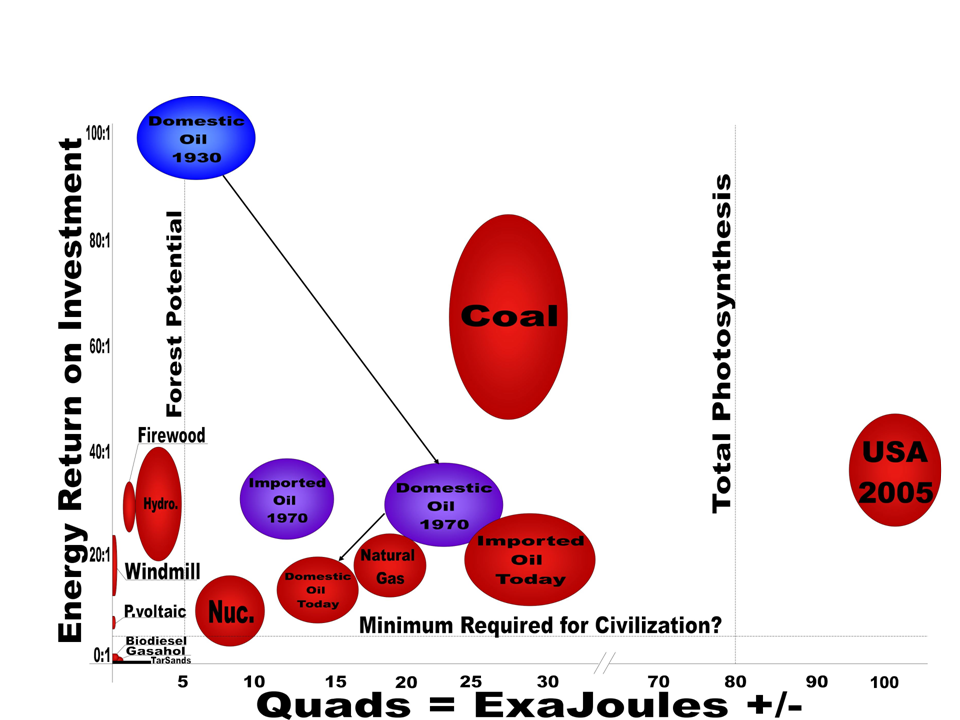
3) Oil imports, on which the U.S. is highly dependent, will likely fall even faster than net production does. The idea in the "Export Land Model" is that demand for oil in countries which are still net exporters will continue to grow exponentially even as production declines, leading exports to decline significantly faster than production. Explanation of and support for this idea is provided at the link above.
So, the world, and the U.S. especially (Europe is much more energy-efficient), is looking at a large and rapid loss of an energy source on which it's completely dependent - for the production of fertilizers, production and transport of food, manufacture of medicines and about every other product in our modern lives, and transport of people from home to stores and work every day (not to mention air travel). So far, the most serious U.S. effort to prepare for this transition has been the invasion of Iraq (see "Is the Bush administration aware of this?" down the page at this site).
Sunday, May 04, 2008
Laid Off
On the last day of April, at 4pm, I was informed that my services were no longer needed at the company. It was not a complete surprise by any means, as it had seemed for a while like it was not the best fit. Now, I'm cleaning up the house a bit and getting started on the next job search. If you have suggestions about where I should look for work, or, more generally, what I should do with my free time, please let me know.
Saturday, February 02, 2008
Long Time No Update
January was a bit trying as I spent most of it sick. I caught two colds in a row, presumably from our adorable little day care vector, and wound up with one of the bacterial sinus infections to which I am prone. After a course of antibiotics, I am much better.
Back on my bicycle, I have found that the new Blue Bottle cafe is a very easy detour on my ride to Caltrain in the morning. The espresso blend they for the cafe is mostly Central American and has a flavor palate of roasted nuts, brown sugar, maybe cinnamon and orange peel, and just straightforward earthy brown coffee. A little acid for my taste but delightfully complex. If only they had food before 8am.
I am disappointed but not terribly surprised that John Edwards has left the Democratic primary race. In his place, I have no idea whether to support Obama or Clinton. Out of perennial disgust for the Democrats, starting after the 2002 midterm elections, I registered Green. I had meant to re-register Democratic to be able to vote for Edwards, but now the point is sort of moot, and it doesn't really matter whether I "support Obama or Clinton". Since I'm in California, it doesn't matter who I vote for in the general election.
Work is still going along. As in many areas, every bit more I learn makes me aware of how little I know.
Back on my bicycle, I have found that the new Blue Bottle cafe is a very easy detour on my ride to Caltrain in the morning. The espresso blend they for the cafe is mostly Central American and has a flavor palate of roasted nuts, brown sugar, maybe cinnamon and orange peel, and just straightforward earthy brown coffee. A little acid for my taste but delightfully complex. If only they had food before 8am.
I am disappointed but not terribly surprised that John Edwards has left the Democratic primary race. In his place, I have no idea whether to support Obama or Clinton. Out of perennial disgust for the Democrats, starting after the 2002 midterm elections, I registered Green. I had meant to re-register Democratic to be able to vote for Edwards, but now the point is sort of moot, and it doesn't really matter whether I "support Obama or Clinton". Since I'm in California, it doesn't matter who I vote for in the general election.
Work is still going along. As in many areas, every bit more I learn makes me aware of how little I know.
Subscribe to:
Posts (Atom)